SaaS SEO agency
SaaS SEO agency: organic growth for software companies
SaaS SEO services built around sign-ups, demos and pipeline, on Google and in AI answers.
Get a first 100% free analysis of your website.
SEO Montreal provides SaaS SEO services to B2B and product-led software companies: bottom-of-funnel pages, programmatic SEO within Google’s spam policies, documentation SEO, JavaScript rendering, international sites and AI search visibility.






SaaS SEO case studies
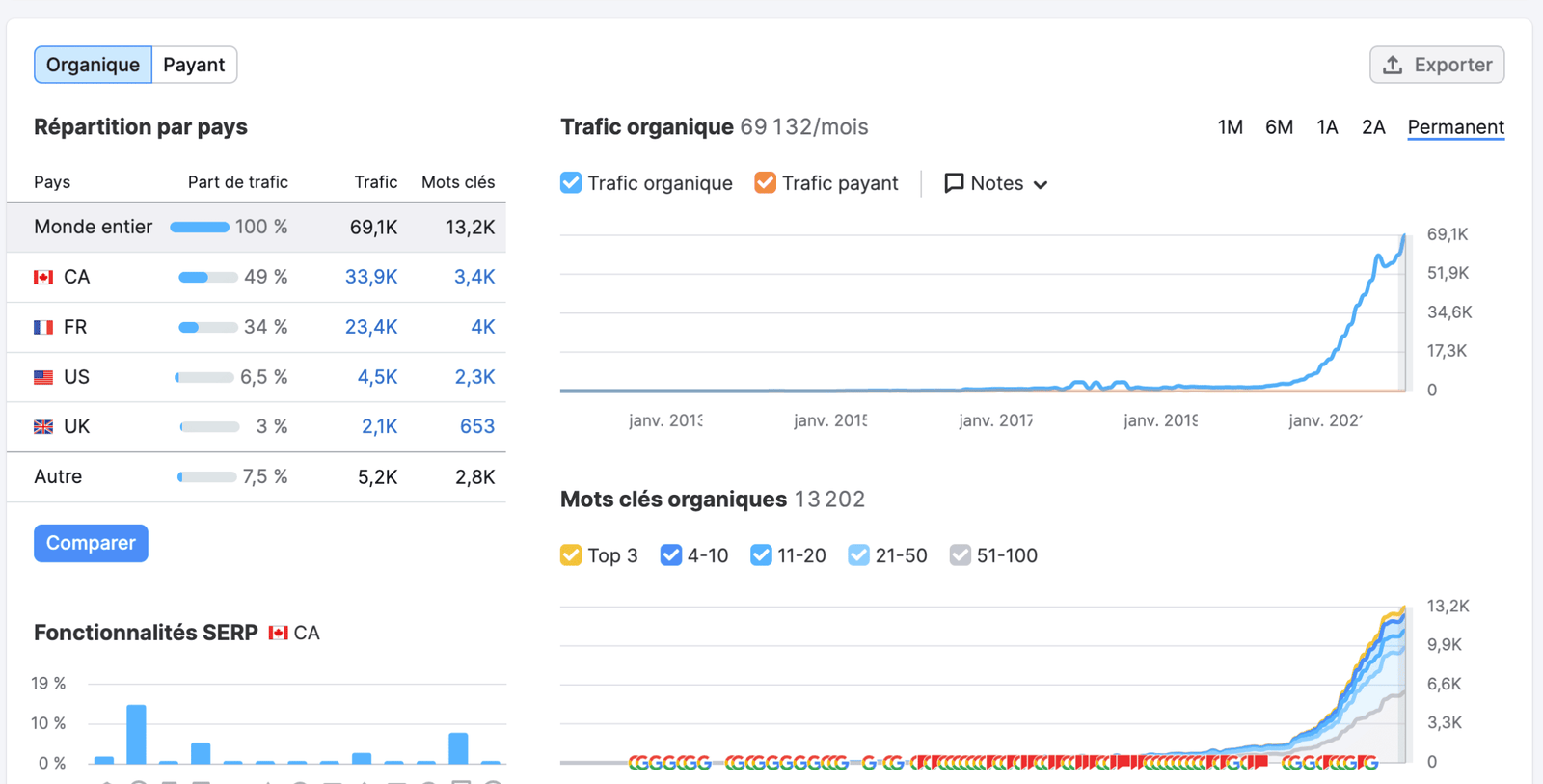
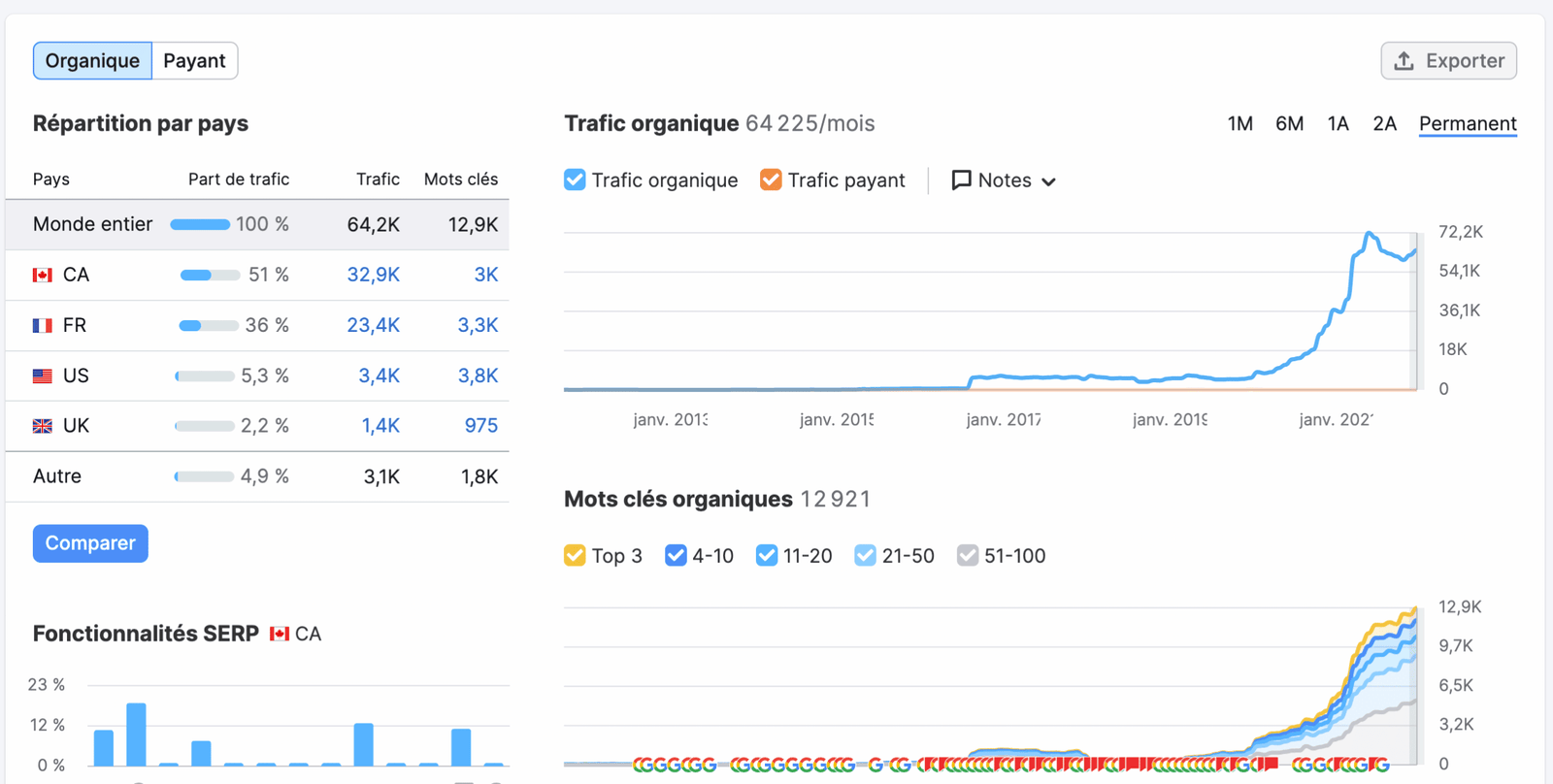
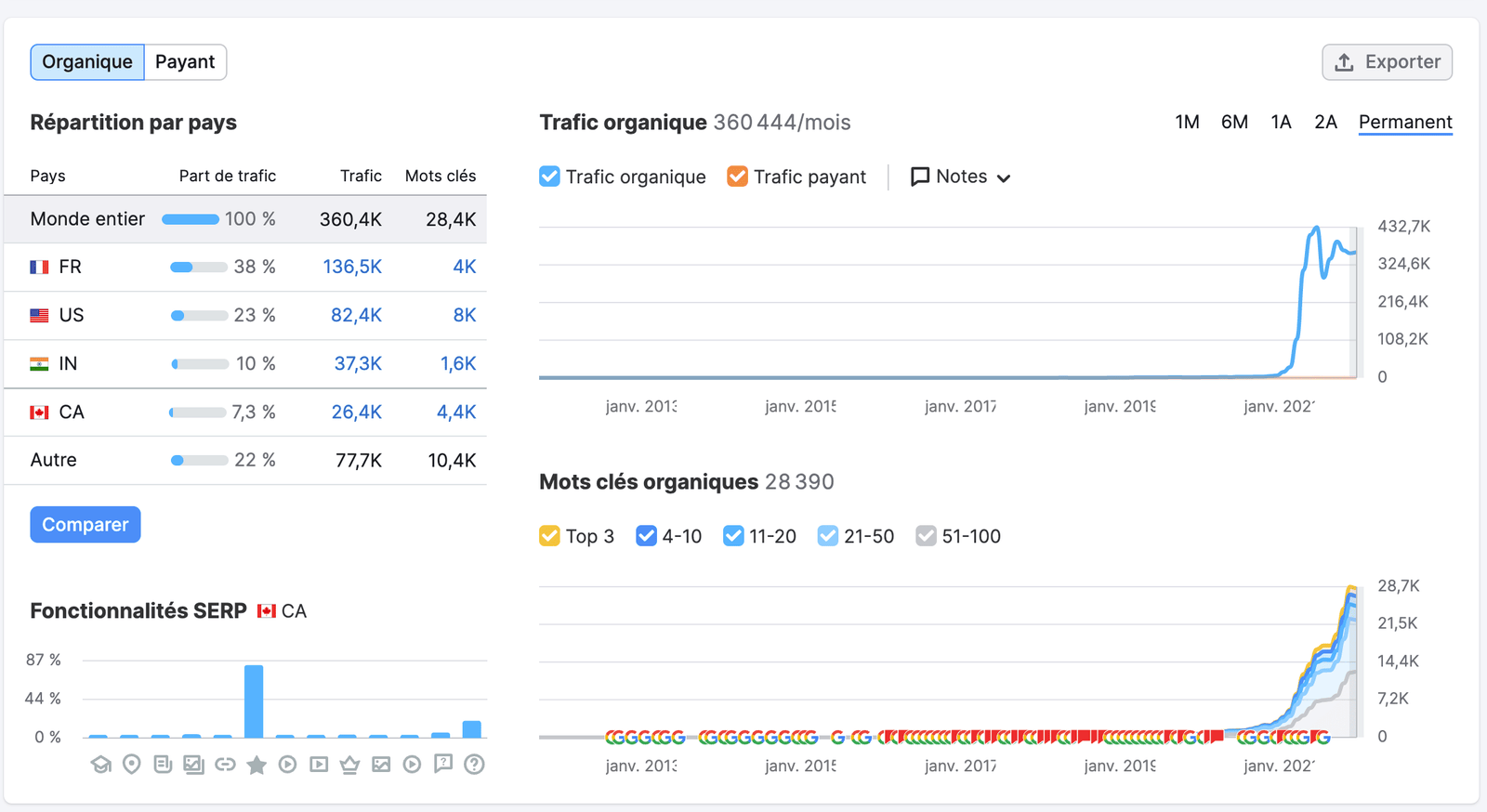
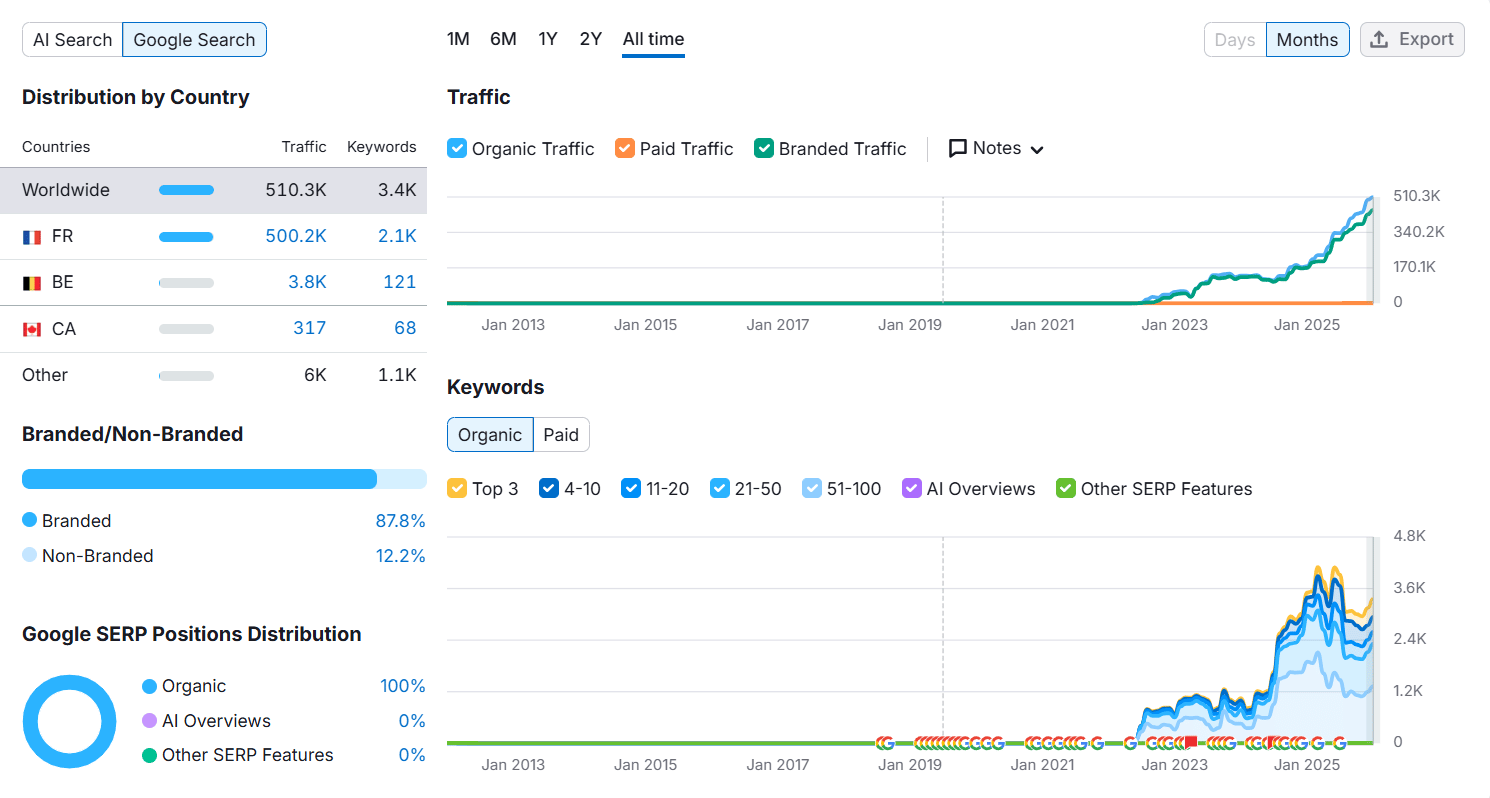
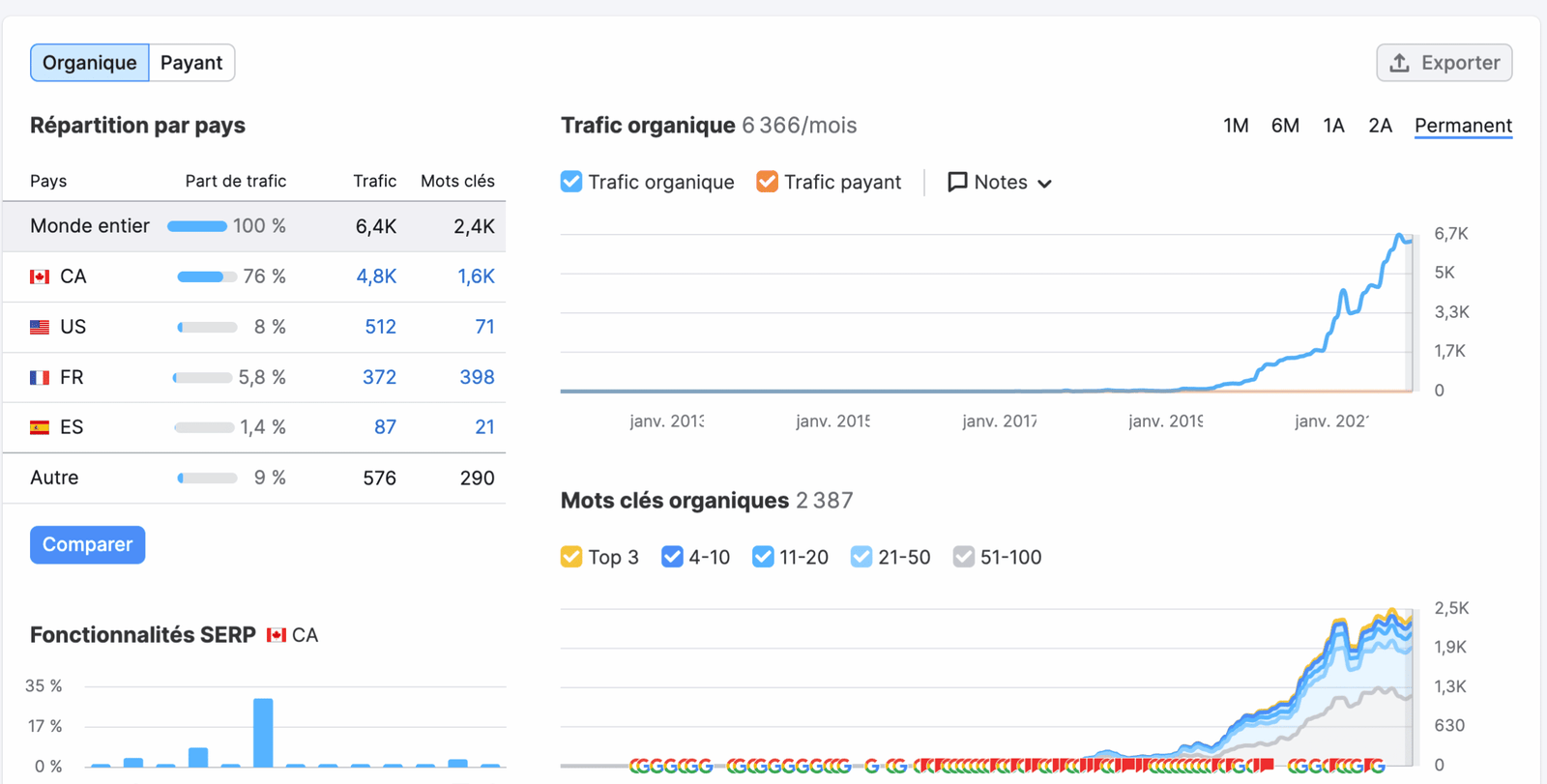
Our published case studies are anonymous, and none is a SaaS company. The closest are two online platforms: a dating platform at 69,100 visits per month and a legal directory at 64,200 visits per month. All results are on our SEO case studies page.
Our SaaS SEO services
Six areas of work, from the pages closest to a sign-up to the technical foundations a software site needs to rank.
Bottom-of-funnel pages that convert
We build feature pages, use case pages by role and industry, an integration page for each tool your product connects with, and alternatives and comparison pages. Comparison pages stay factual and fair: public pricing and features, a visible update date and the cases where the other product fits better. We describe competing products accurately and respectfully, and your team approves every claim in Google Docs before it goes live.
Programmatic SEO without scaled content abuse
Integration directories, templates or “software for [industry]” pages can scale to thousands of URLs. Google’s spam policies define scaled content abuse as pages generated “for the primary purpose of manipulating search rankings and not helping users,” generative AI and scraping included. We publish a programmatic page only when it carries data unique to your product: real setup steps, real fields, real examples. Thin variations stay out of the index.
Product-led content
Product-led content solves the reader’s problem with your product in the workflow: a tutorial that shows the real interface, a template people can copy, a guide built on the steps a user takes in the app. We pick blog topics where your product is a natural part of the answer, so an article attracts readers who fit your ideal customer profile. Original product data can also earn backlinks through digital PR.
Documentation and help-center SEO
Docs and help-center articles often rank for integration, setup and error searches, and they reach prospects evaluating the product as well as existing customers, which supports retention. We fix the site architecture (subdomain or subfolder, versioned docs, duplicate pages across versions, canonical tags), link articles back to product pages and rewrite titles to match how people search. Login-only pages stay out of the index.
JavaScript rendering for single-page apps
Google processes JavaScript pages in three phases: crawling, rendering and indexing. Its JavaScript SEO basics recommend server-side or pre-rendering, which is faster for users and crawlers and works for bots that can’t run JavaScript. On React, Vue or Angular sites, we check that each route has its own URL through the History API instead of fragments, that links are real HTML links with an href and that error routes lead to a 404 or a noindex. We also work on Core Web Vitals.
AI search visibility for software brands
Buyers ask ChatGPT, Perplexity, Gemini and Google AI Mode to shortlist tools, compare plans or explain an integration. Google states that its AI features need no special optimization: a page must be indexed and snippet-eligible to appear as a link. Our GEO agency keeps your pricing, feature, integration and security facts clear and current on your site and docs, and consistent on review sites like G2 and Capterra.

Ready to grow your SaaS pipeline organically?
Send us your website and book a free 30-minute consultation, with no commitment.
Everything about SaaS SEO
9 min read·By SEO Montreal™
What is SaaS SEO?
SaaS SEO is the search engine optimization of software-as-a-service companies: the marketing site, product and feature pages, integrations, documentation and content. It uses the same foundations as any SEO, including technical work, content and backlinks, and adds work specific to software: JavaScript apps, templated pages at scale, a subscription funnel measured in trials, demos and recurring revenue, and buyers who compare tools in AI answers before they visit a site.
Why SaaS SEO is different
Software buyers rarely start with your brand name. They search for a problem, a feature, an integration with a tool they already use or an alternative to the software they want to leave. Those searches sit close to a trial or a demo, and they are spread across hundreds of small queries instead of a few big ones. SaaS SEO covers that long tail with pages that help a buyer decide.
The site is unusual too: a marketing site, an app often built as a JavaScript single-page app, a help center, product docs and sometimes thousands of templated pages, each with its own crawl and indexation issues. Results are judged on sign-ups, trials, demos, qualified leads and recurring revenue, and organic sign-ups can ease customer acquisition costs when paid channels get expensive. It’s the revenue logic we apply as a B2B SEO agency.
SaaS SEO by growth model
Product-led and self-serve SaaS
When users sign up without talking to sales, organic pages feed the free trial or freemium funnel directly. We focus on templates, integrations, use cases and product-led tutorials, and we track sign-ups and activation by landing page.
Sales-led B2B SaaS
Long sales cycles with several decision-makers need content for each role: the user, the manager, IT and security, finance. We track organic demo requests by landing page so your team can trace pipeline back to the pages that started it.
Vertical SaaS
Software built for one industry, such as construction, clinics, law firms or retail, competes on industry vocabulary more than on software jargon. We write in the buyer’s language, with use cases from their daily work. For apps sold to online stores, we also draw on our e-commerce SEO agency work on catalogs and marketplace listings.
Early-stage and established SaaS
An early-stage SaaS with little authority starts with the long tail it can win: integrations, alternatives and specific use cases. An established SaaS usually needs the reverse: cleaning up thousands of indexed URLs, merging overlapping articles, fixing templates and protecting the rankings it already has.
International SaaS SEO and hreflang
Software is sold across borders early, so one product often needs English, French, Spanish or German pages, and sometimes country versions with local pricing. Google’s hreflang guidelines require each language version to list itself and every other version, and the tags only work when pages point to each other. The x-default value covers users whose language or region matches no version.
We set up hreflang in HTML, HTTP headers or the sitemap, align it with same-language canonical tags, and run keyword research market by market, because buyers in each country use their own vocabulary for the same software.
Our SaaS SEO method in 4 steps
Map your SaaS search demand
We look at which competitors, review sites and communities such as Reddit rank for your category, what your site captures today, which templates waste crawl budget and which feature, integration and alternative searches are missing. You get a keyword plan by funnel stage and search intent that our team then executes.
Prioritize the pages that drive sign-ups
We rank keywords by value to the business rather than by volume: a search for an integration or an alternative often brings more trials than a broad informational query. We usually start with the pages closest to a sign-up or a demo, measure their return on investment, then move on to the next set.
Execute in your CMS or codebase
Our team works in your CMS or with your developers on templates, rendering, structured data, internal linking, title tags, meta descriptions and sitemaps. Content goes through Google Docs for your approval, product claims included.
Measure trials, demos and MRR monthly
The monthly report tracks rankings, indexation and organic traffic in Search Console and Google Analytics, but the KPIs we discuss are sign-ups, trials, demo requests, pipeline and MRR from organic search. The mandate renews monthly with 30 days’ notice and no long-term contract. Everything we’ve built stays yours.
How much do SaaS SEO services cost?
A focused SaaS SEO mandate starts at $1,500 per month and a growth mandate runs around $2,000 per month, the average across our clients; larger SaaS sites move to a custom mandate. The monthly cost depends on the number of pages and templates, the languages and markets, the competition in your category and the state of the site at the start, not on a package grid. Google Ads campaign management is included with no management fee. Details are on our SEO pricing page.
Why choose our SaaS SEO agency
Our team has worked with more than 500 clients in over 25 industries and focuses on organic search and GEO, with Google Ads in support. The mandate is monthly, our SEO team executes directly on your site or with your developers and we work in English and French. SEO Montreal was founded and is led by Raphaël Larouche. Meet our team before you talk to us.
SaaS SEO FAQ
It depends on the site’s authority, the competition in your category and how fast changes ship. Technical fixes and pages for low-competition integrations or use cases can move within weeks. Category terms, where established software brands and review sites hold the first results, often take several months. We set realistic goals at the start and show you every month where rankings, sign-ups and demos stand.
Yes, if they are fair. Buyers search for alternatives and comparisons, and a factual page helps them decide. We base each comparison on public, dated information, show where each product fits best and update the page when pricing or features change. Your team, with legal counsel when needed, approves every claim about another company, because a one-sided page loses the buyer’s trust.
It is when every page helps a user. Google’s spam policies target pages generated mainly to manipulate rankings, generative AI included. A programmatic integration or template page holds up when it carries unique data, real steps and a real use for the reader. We test a sample of pages first, watch indexation and engagement, and keep thin variations out of the index.
Yes. Google renders JavaScript, but rendering comes after crawling and not every bot runs JavaScript, so server-side rendering or pre-rendering is safer for pages that must rank. We check that each route has its own URL, that links are real HTML links, that error pages lead to a 404 or a noindex and that important content appears in the rendered HTML.
Both can rank: Google leaves the choice to your business. What matters more is that docs are crawlable, linked from the marketing site and linked back to product pages. A subfolder can simplify internal linking; a subdomain can suit docs on a separate platform. We look at your stack and traffic before recommending a migration, since moving docs carries its own risk.
Search Console shows the queries and pages that bring visitors, and Google Analytics shows organic sessions, sign-ups, trials and demo requests by landing page. Your team can then match those accounts with the ones that became paying customers, which ties pipeline and MRR back to organic pages and topics. Every attribution model has limits, so we explain how we read the data.
AI assistants build their answers from pages they can find and trust. We state your pricing, features, integrations and security details clearly on indexable pages, keep them consistent with your docs, review sites and community threads, and keep them current. We then check how ChatGPT, Perplexity, Gemini and Google AI Mode describe your product and update your pages behind inaccurate answers.
Yes, once there is a product people can sign up for and a clear target customer. An early-stage SaaS usually starts with a focused mandate on long-tail integrations, alternatives and use cases, where a young domain can compete. Larger or multilingual SaaS sites move to a growth or custom mandate. The 30-minute consultation is free, with no commitment.
Let’s talk about your SaaS SEO
Book a free consultation: 30 minutes, no commitment, a reply within 24 business hours.
Get a first 100% free analysis of your website.